Insights
Supporting inclusive thinking in initial teacher training
Insights from analysing trainees' responses to over 4,000 scenarios.
This year, teacher educators in every region of England have been using Proxima’s scenarios to prepare trainees to teach pupils with special educational needs and disabilities (SEND).
Taken together, their responses comprise an unusual dataset, offering insights into the most challenging aspects of inclusive practice and hinting at promising strategies to support new teachers in the future.
Here are three recommendations to help teacher educators and their trainees, based on an analysis of over 4,000 responses to scenarios about SEND:
- Underline that great teaching is inclusive teaching
- Boost trainees’ confidence by asking them these two questions
- Talk about emotions and values
1. Underline that great teaching is inclusive teaching
In a powerful recent article, inclusion expert Margaret Mulholland wrote about the importance of helping trainees grasp “how each element of ‘quality teaching’ is designed to work first for pupils who find learning the hardest.” To achieve this, she recommends providing “structured opportunities to practise decision making” within training.
Trainees’ responses to scenarios on Proxima provide clear support for this recommendation. Without support, trainees consistently find it more challenging to respond to scenarios mentioning SEND than to similar scenarios that do not.
For example, in the scenario below, when we added an extra phrase mentioning Asha’s additional needs (highlighted in bold), trainees were significantly less likely to check Asha’s understanding before moving on.
Scenario
You have been teaching your class how to convert between metres and centimetres.
You are working with Lloyd and Asha, [a pupil with additional needs related to communication and interaction,] and you want to assess their understanding.
YOU: “Can anyone tell me how we would write 125 cm in metres? … Lloyd, what do you think?”
LLOYD: “1.25 metres.”
What would you say first? Justify your decision.
- “Thanks Lloyd. It seems like we’re on the right track with this. Let’s all now try some practice questions.”
- “Thanks Lloyd. Asha, can you explain how Lloyd arrived at that answer?
Trainees who selected Option 1 typically focused on the risk of causing Asha anxiety by asking her to speak, rather than focusing on the risk of making an assumption about her understanding.
The challenge appears to be supporting trainees to consider the role of effective questioning as a foundation for inclusion. Following Mulholland’s advice, scenarios like this provide opportunities for trainees to make decisions and reflect on their decision-making processes.
2. Boost trainees’ confidence by asking them these two questions
Trainees’ responses to scenarios underline the need to build confidence alongside expertise, echoing inclusion expert Rob Webster’s conclusion that “every education system needs its teachers to be confident and competent in relation to SEND” (Webster, 2022).
A simple way to build confidence is to ask trainees who have been learning about a particular pedagogical principle or strategy the following two questions:
-
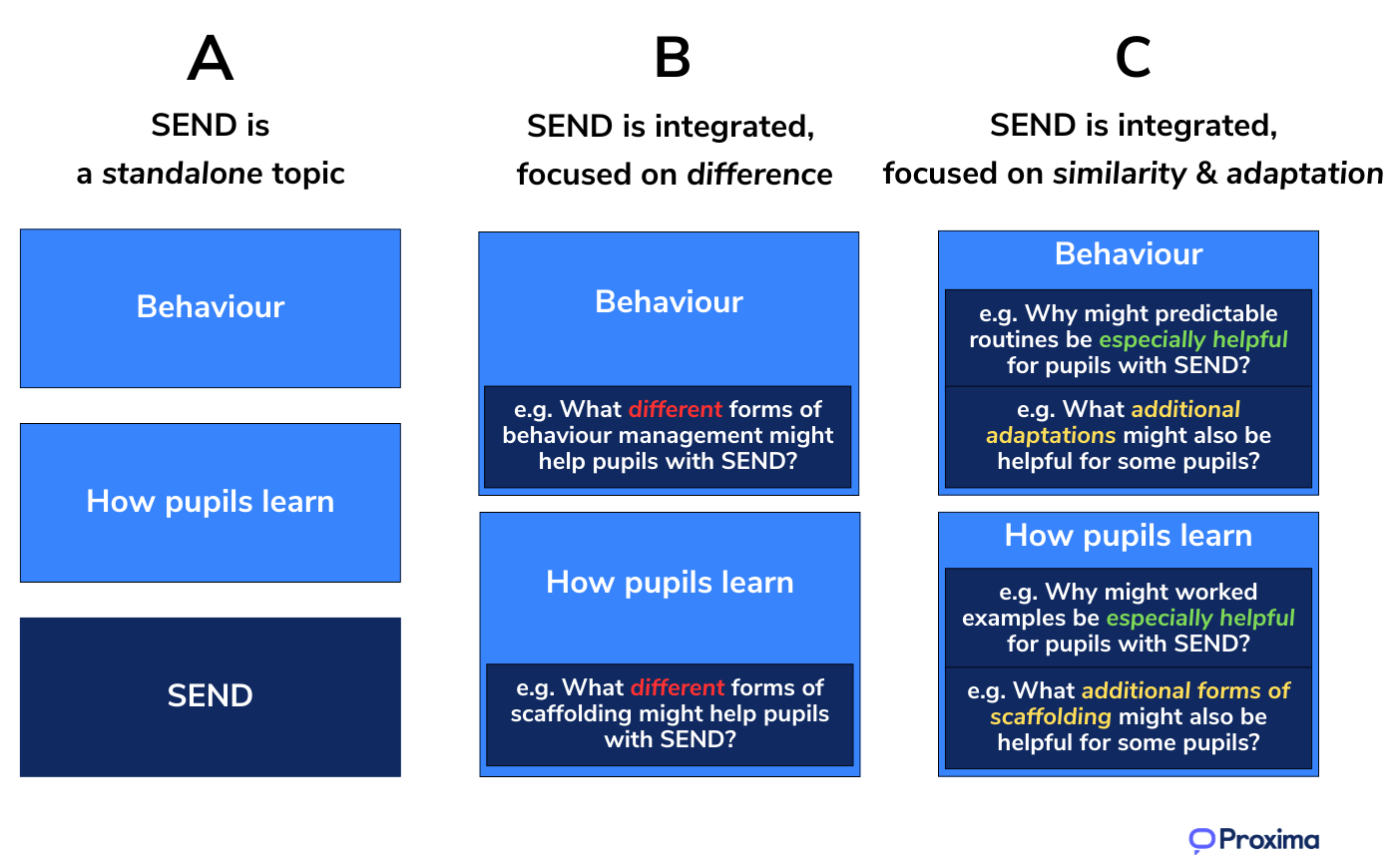
“Why might this principle be especially important for pupils with additional needs?” This question is designed both to prompt trainees to reflect on specific barriers facing pupils with additional needs and consider the enduring relevance of great teaching. For example, why might predictable routines be especially helpful for pupils with anxiety?
-
“What additional adaptations might also be helpful for some pupils?” This question is designed to recognise that the way in which particular strategies are applied might be adapted, without implying that a fundamentally different pedagogical approach is being adopted. For example, all pupils might receive scaffolding, but the speed with which scaffolding is removed might be slower for some pupils.
These questions acknowledge that additional adaptations will be necessary for some pupils, while also recognising the Education Endowment Foundation’s warning that “searching for a ‘magic bullet’ can distract teachers from the powerful strategies they often already possess” (EEF, 2020).
This approach is illustrated in the third column (C) in Figure 1, below. It is contrasted with alternatives that either treat SEND entirely as a standalone topic (A) or seek to integrate SEND across the curriculum, but in ways that primarily emphasise difference (B).
3. Talk about emotions and values
The psychologist David Yeager talks about an apparent dilemma faced by adults when working with young people: whether to be ‘enforcers’ or ‘protectors’. Enforcers have high standards but offer little support, while protectors are supportive but can lower their expectations (Yeager, 2024).
For Yeager, an important insight is that both enforcers and protectors are almost always well-motivated; they care deeply about the wellbeing and success of the young people they’re working with, and they believe that their approach will help them.
While Yeager was not writing specifically about teacher training or inclusion, his work has clear relevance. In many scenarios, we see trainees wanting to protect their pupils, even if doing so inadvertently makes it harder for them to learn. For example, in a scenario that asked trainees whether they wanted to use a quiz to activate prior knowledge, some trainees rejected this option on the grounds that a quiz could be scary for pupils with low confidence in the subject.
Ultimately, Yeager argues that the protector-enforcer dilemma is an illusion and that a third ‘high-standards, high-support‘ route is available. However, helping enforcers or protectors take this third route requires more than just presentating them with new data; it requires direct engagement with their values, and an explanation of how new choices are consistent with their existing values (Yeager, 2025).
How might we apply these insights to help trainees become effective inclusive teachers? Alongside the development of knowledge and skills, it is likely we’ll need to provide trainees with opportunities to talk about the emotions they might feel in the classroom, as well as their broader motivations for teaching. For example, if you anticipate that some trainees may be tempted not to check the understanding of pupils with SEND for fear of causing anxiety, you could ask them to compare potentially useful adaptations designed to reduce anxiety (e.g. extending wait time) with maladaptations that hinder learning (e.g. leading questions).
Pilot opportunity: Inclusion in ITT
From September 2026, Proxima is launching an inclusion pilot for SCITTs and universities delivering initial teacher education. The pilot will focus on the use of scenarios to improve trainees’ confidence and understanding about inclusive teaching.
If you would like to find out more, register here to join our free webinar at 3pm on Thursday 26th February.
References
- EEF (2020). SEND in Mainstream Schools. [URL]
- Mulholland, M. (2025). Do we really need better ITT on SEND?
- Webster, R. (2022). The Inclusion Illusion. [URL]
- Yeager, D. (2024). 10 to 25: The science of motivating young people.
- Yeager, D. (2025). A Scalable, Theory-Based Intervention to Influence Teachers’ Student Engagement Practices Improves Academic Performance.
If you enjoyed this post, sign up to our newsletter here.